

Every investment firm already has an edge. The problem is that most of it is trapped in places the research process cannot reason over: a Snowflake table, a partner’s Notion page, the model someone saved to Box, or the memo everyone remembers but nobody can find.
That is not a data problem. It is an institutional memory problem.
Most AI research tools begin every conversation as if the firm were founded that morning. They can read a filing and summarize an earnings call, but they do not know why you own the position, what changed your mind last quarter, which numbers the team trusts, or where the original work lives.
An investment team should not have to choose between a model that knows the market and systems that know the firm. The two should be part of the same research surface.
Your edge is already inside the firm
The best investment teams have already built a body of knowledge the rest of the market does not have. It lives in internal research, proprietary datasets, old models, meeting notes, investment memos, and the accumulated judgment behind every position. That knowledge should compound. Too often, it just accumulates.
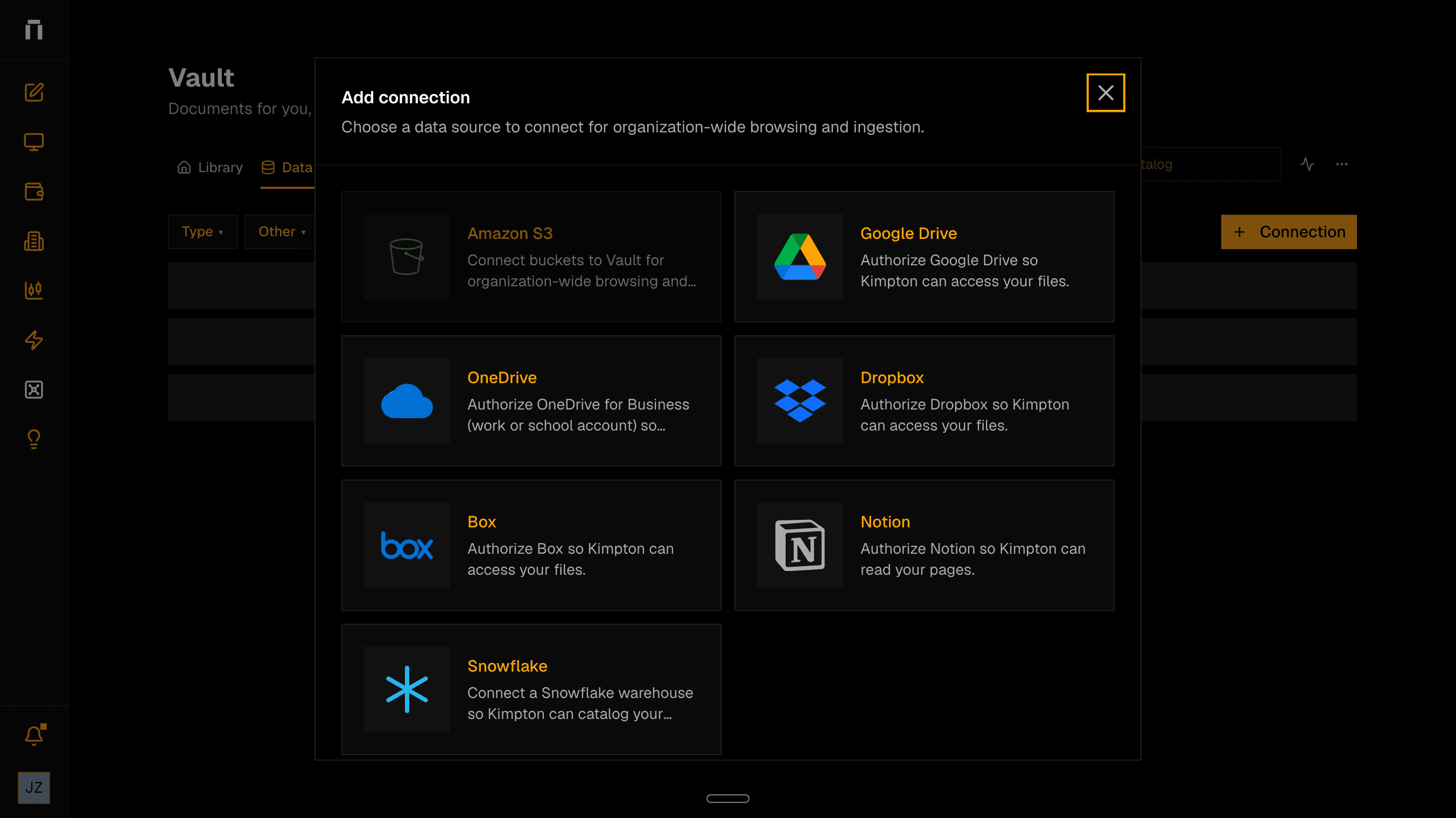
Today, we are bringing Snowflake, Notion, Box, Dropbox, OneDrive, Google Drive, and Amazon S3 into Kimpton. Connect the systems your team already uses, choose the resources Kimpton can access, and put the firm’s private knowledge alongside filings, transcripts, market data, and portfolio context.
The connector catalog reaches across the systems where investment teams already work: Google Drive, OneDrive, Dropbox, Box, Notion, Amazon S3, SharePoint, Slack, Microsoft Teams, Snowflake, Databricks, FactSet, FRED, and more. Storage, collaboration, warehouses, and research platforms should not become separate islands of firm knowledge.
That private context joins the data Kimpton already brings to the table: equities, fundamentals, sell-side estimates, SEC filings, insider trades, 13F holdings, earnings transcripts, M&A activity, options chains, executives and management, news and macro data, and internal documents. Kimpton connects what the firm knows with what the market knows.
A research system should remember
Ask why the firm still owns a position. Kimpton can inspect the original memo in Drive, compare its assumptions against the latest filing, query the relevant Snowflake data, account for the current portfolio exposure, and produce an updated view with the source trail intact.
This is not another searchable archive. The point is to make the firm’s memory useful in the moment a decision is being made. Private research becomes part of the same loop as public information: find the evidence, test the thesis, inspect the sources, and turn the result into a report, dashboard, or trade proposal.
The analyst should not be the API
Today, analysts are often the integration layer. They find the document, export the table, copy the relevant cells, explain the history, and paste everything into the next tool. Then they repeat the process when the data changes.
Every export, download, and re-upload is work the system should do. It also creates another opportunity for the context to go stale or the source trail to disappear. A connector should fade into the background: the data stays in the system that owns it, while Kimpton works from the resources the team has explicitly made available.
One brain across the research stack
Kimpton should not feel like another destination where information goes to get stranded. It should be the research layer across the systems an investment firm already depends on—the place where market knowledge, portfolio context, and the firm’s own memory become usable together.
A shared brain does not replace the judgment of the investment team. It gives that judgment somewhere to live, compound, and show up in the next decision.
Available now
The new connectors are available in Kimpton now. Connect the systems your team depends on and start building research on top of what the firm already knows.